Maextro V800 Brake Pedal Bracket Failure: What the Tests and Chinese Standards Actually Show
A fact-checked review of the Maextro V800 brake-pedal bracket controversy, the manufacturer's response, and what GB 21670, GB 7258 and QC/T 788 can—and cannot—prove.
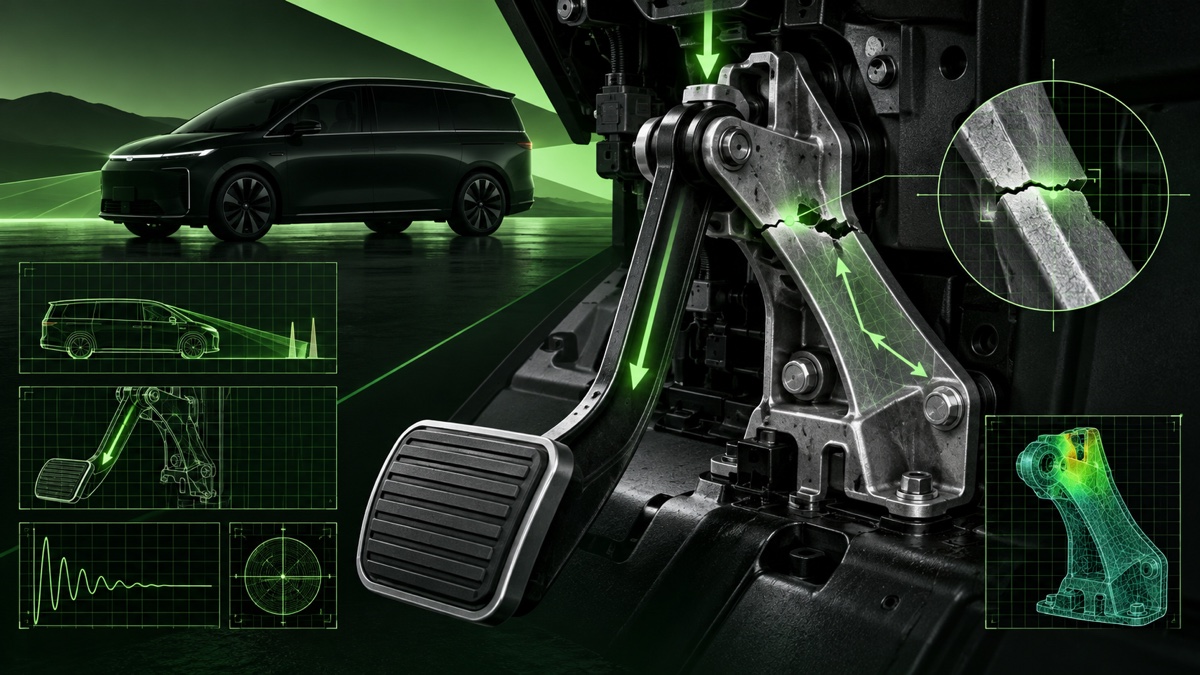
On 8 October 2026, a Dongchedi test account reported that brake-pedal support brackets fractured on three new Maextro V800 vehicles during repeated 100-to-0 km/h emergency stops. Maextro responded the same day, calling the test a “non-standard extreme” condition, stating that delivered vehicles had not experienced the same failure in actual use, and promising both a component redesign and a free upgrade option for delivered users.
The repeated fracture report is a serious safety signal. It is not, on its own, a final regulatory finding. The manufacturer's statement is important evidence too, but it is not an independent investigation or a published conformity file.
The right way to read the incident is to separate four questions:
- What did the tester report?
- What did Maextro acknowledge and dispute?
- Which standards actually address whole-vehicle braking, operating safety and pedal-component testing?
- What evidence is still missing before anyone can make a defensible cause or compliance conclusion?
At a Glance
| Issue | What is established in public sources | What remains unresolved |
|---|---|---|
| Test event | Dongchedi reported three V800 bracket fractures during repeated 100-to-0 km/h stops | Independent replication, complete raw data and chain of custody |
| Failure timing | Contemporary reports place failures between the second and fourth repeated stop | Exact condition and prior load history of every specimen |
| Peak force | Reporting on the third vehicle cites approximately 1,612 N | Measurement method, vector and equivalence to a bench test |
| Manufacturer position | No delivered-user fracture reports; test described as non-standard and extreme | Root cause, component population and quantified safety margin |
| Manufacturer action | Design optimization, optional free upgrade and validation/quality review announced; customer service reportedly targeted November for rollout | Final design, confirmed vehicle range, detailed service bulletin and whether an official recall is required |
| Current whole-vehicle brake standard | GB 21670-2025 | Model-specific conformity evidence was not published in the statement |
| Pedal-device reference | QC/T 788-2018, a recommended industry standard | Direct applicability to the exact V800 pedal construction and test equivalence |
| Future operating-safety edition | GB 7258-2026, effective 1 July 2027 | Why and how Maextro says its validation exceeds the future edition |
What the Test Account Reported
Dongchedi's published account, as summarized by multiple contemporaneous reports, said three new V800s experienced fracture of the brake-pedal support structure during repeated full braking from 100 km/h. The reported failures occurred on the third stop for one vehicle, the fourth for another and the second for the third vehicle.
Interface News reported that the third vehicle recorded a maximum pedal force of 1,596 N on its first stop and 1,612 N on the stop when the bracket fractured. It also reported that the three vehicles were produced across August and September 2026, while the exact component version, supplier batch and configuration commonality were not public.
Those details should be described as tester-reported measurements, not as findings from a regulator or independent laboratory. The original full test video later became unavailable on several platforms. That makes preservation of raw sensor data, complete footage, vehicle identification, pre-test inspection and failed parts especially important.
What Maextro's Response Says—and Does Not Say
Maextro's 8 October statement contains four material claims or commitments:
- Its braking system completed development and validation against requirements it describes as higher than GB 21670-2025, GB 7258-2026 and QC/T 788-2018.
- Since first customer deliveries, it says no brake-pedal bracket-base fracture has occurred in actual user scenarios.
- It characterizes the test shown online as a non-standard extreme condition.
- It will optimize the component, offer delivered users a free upgrade option, and review design validation, test boundaries and production-quality management.
The response does not publish the tested component specification, test reports, load-displacement curves, failure analysis, affected vehicle-identification range, independent review or root-cause conclusion. It also does not, in the public statement reviewed, describe the action as a regulatory recall.
On 9 October, customer-service information reported by IT Home said the upgrade plan was expected to be confirmed by late October and rolled out progressively from November. The report said unshipped vehicles would receive the optimized component before delivery and described the action as an upgrade rather than a recall. This is useful implementation information, but it is not a substitute for a detailed manufacturer service bulletin or regulator notice.
The combination matters. A voluntary redesign does not prove the original design was legally noncompliant. Equally, the absence of customer failure reports does not answer the engineering question raised by similar fractures across three reported test vehicles.
The Three Standards Answer Different Questions
| Reference | Level | Status on 13 October 2026 | Question it can help answer |
|---|---|---|---|
| GB 21670-2025 | Passenger-car braking system | Mandatory; effective 1 January 2026 | Does the defined passenger-car braking configuration meet prescribed system requirements and tests? |
| GB 7258-2017 | Whole-vehicle operating safety | Current edition | Does the vehicle meet current operating-safety conditions for road use and inspection? |
| GB 7258-2026 | Next whole-vehicle operating-safety edition | Published; effective 1 July 2027 | Is the vehicle being prepared for the next mandatory operating-safety baseline? |
| QC/T 788-2018 | Brake and clutch pedal device | Current recommended industry standard | Does an applicable pedal assembly meet the adopted bench strength, deformation and durability criteria? |
Listing all three numbers is not the same as publishing evidence against them. A useful conformity statement identifies the applicable clauses, edition, vehicle or component configuration, test organization, method, result and treatment of variants.
GB 21670-2025: Whole-System Braking
GB 21670-2025 is China's current mandatory passenger-car braking standard. It replaced the 2008 edition on 1 January 2026.
It addresses the braking system at vehicle level: service, secondary and parking braking; anti-lock and electronic control; warnings and fault behavior; and interactions relevant to electrified vehicles. It is broader than a pedal-bracket bench test.
The most common interpretation error is to treat a maximum driver pedal force used in a braking-performance test as the bracket's structural fracture rating. These are different quantities. One asks how much driver input is permitted or required to achieve a braking result. The other asks whether a component survives a controlled structural load and durability sequence.
The V800 event can be relevant to GB 21670 because the pedal and support transmit the driver's braking demand. But a formal noncompliance finding requires the relevant clause, exact configuration and prescribed evidence—not only a force number copied from a media test.
GB 7258-2026: A Future Edition, Not Today's Baseline
The official national standards catalogue says GB 7258-2026 was published on 27 August 2026 and becomes effective on 1 July 2027. GB 7258-2017 remains current until then.
GB 7258 is a broad mandatory standard for the operating safety of power-driven vehicles. Its scope includes braking but extends far beyond it. Maextro is free to validate a vehicle early against the 2026 edition or to adopt internal margins above it. The public statement, however, does not show which clauses were exceeded or by how much.
Therefore, “higher than GB 7258-2026” should be read as a manufacturer validation claim about a future standard, not as evidence that the 2026 edition was already the enforceable rule on 8 October 2026.
QC/T 788-2018: The Closest Component-Level Reference
QC/T 788-2018 is the most directly relevant cited reference for pedal-device bench testing. The official standards platform classifies it as a recommended, not mandatory, automotive industry standard. It was published in July 2018 and has been effective since January 2019.
Reporting based on the standard describes a controlled longitudinal strength test and repeated durability testing. It also notes an important scope issue: the standard directly addresses specified mechanically hinged metal pedal devices, while other pedal types may be tested by reference. The exact V800 assembly construction and Maextro's declared applicability basis therefore matter.
This is why the reported 1,612 N peak cannot settle the argument alone:
- A vehicle stop produces a dynamic force-time history, not necessarily the specified bench loading sequence.
- Pedal contact position and force direction change the moment at the bracket.
- The part may have prior loading, conditioning or production variation.
- A peak sensor value does not disclose hold time, repetitions or measurement uncertainty.
- Direct applicability depends on the pedal assembly covered by the standard.
The media test may reveal a failure mode worth investigating even if it is not a formal QC/T 788 test. Conversely, citing a prior QC/T 788 validation does not explain why three reported assemblies fractured unless the production configuration and test boundary are shown to be representative.
What Evidence Would Resolve the Dispute?
1. Preserve the vehicles and failed parts
Record vehicle identification numbers, production dates, odometer readings, component codes, supplier and batch identifiers. Preserve fracture surfaces and maintain chain of custody before cutting, cleaning or destructive analysis.
2. Publish the complete test method
Disclose vehicle load, tires, road and temperature, brake conditioning, number and timing of stops, pedal-force sensor location and calibration, driver posture, input vector, video synchronization and all raw force/deceleration traces.
3. Establish configuration commonality
Determine whether the three assemblies used the same drawing revision, material, fiber content if applicable, mold, cavity, process window, supplier and assembly parameters. Similar failure location is important, but common cause must be demonstrated.
4. Conduct comparative bench testing
Test untouched production samples using the exact QC/T 788 method where applicable, plus justified off-axis and dynamic cases that represent the reported event. State clearly which tests are standard, modified-standard or internal engineering tests.
5. Perform an independent failure analysis
Examine material identity and conditioning, fracture morphology, weld or knit lines where applicable, voids, dimensions, residual stress and evidence of progressive damage. Compare failed and control parts without assuming the cause in advance.
6. Publish the corrective-action boundary
Explain which vehicles receive the upgrade, whether the action covers V800, S800 or a shared part population, what changes, when parts become available, and how users verify completion. If a safety defect is determined, clarify the regulatory recall process.
What Owners and Buyers Should Do Now
- Do not attempt destructive pedal tests on public roads or on your own vehicle.
- Check the official Maextro service channel using the vehicle identification number rather than relying on social posts.
- Ask whether the free upgrade applies to the exact model, production date and component revision.
- Request a written description of the change and whether it is a service campaign, optional upgrade or formal recall.
- Record any abnormal pedal movement, noise, looseness or warning and stop driving if braking response changes.
- Preserve invoices, service records and communications.
- Monitor official manufacturer and Chinese recall-regulator channels for an investigation result or scope update.
Frequently Asked Questions
What happened in the Maextro V800 brake-pedal test?
On 8 October 2026, Dongchedi published a test account saying three new Maextro V800 vehicles experienced brake-pedal bracket fractures during repeated 100-to-0 km/h emergency stops. Public reporting places the failures on the second, third or fourth stop, depending on the vehicle. The original full video was later unavailable on several platforms, so this article attributes the test details to the tester and contemporaneous reporting rather than treating every detail as independently verified.
What did Maextro say about the V800 brake-pedal bracket?
Maextro said its braking system was developed and validated to requirements above GB 21670-2025, GB 7258-2026 and QC/T 788-2018; said no bracket-base fracture had occurred in delivered-user scenarios; characterized the video as a non-standard extreme test; and promised a design optimization, an optional free upgrade for delivered users, and a broader review of validation boundaries and production quality. Customer-service information reported on 9 October said the plan was expected to be finalized by late October, with free upgrades beginning in November, but a detailed official service bulletin was not located.
Does the reported 1,612 N pedal force prove that the V800 passed or failed QC/T 788-2018?
No. A peak force measured during an in-vehicle dynamic stop is not automatically equivalent to a component bench test. A valid QC/T 788 conclusion requires the standard's scope, specimen, fixture, load point and direction, sequence, measurement uncertainty and acceptance criteria.
Is GB 7258-2026 already mandatory?
It is a published mandatory national standard, but it does not take effect until 1 July 2027. GB 7258-2017 remains the current edition as of 13 October 2026. Maextro's reference to the 2026 edition is therefore an early-validation claim, not proof that the future edition is already the legal baseline.
Has an authority determined the cause or ordered a recall?
Not in the authoritative sources reviewed through 13 October 2026. Maextro announced a free upgrade and a review, but the public statement did not provide a root-cause report, independent conformity assessment or recall notice. The cause and regulatory conclusion should therefore be treated as unresolved.
Research and Review
Standardful reviewed the official national and industry standards catalogues, Maextro's 8 October public statement as reproduced in contemporaneous sources, reporting of the Dongchedi test, and follow-up technical reporting. Research was completed on 13 October 2026.
The tester's original complete video and raw data were not available through an enduring primary link during this review. Test details are therefore attributed. No public regulator determination, independent root-cause report or recall notice was located. This article will need updating if Maextro, Dongchedi or a competent authority publishes primary evidence.
Official and Primary Sources
- Maextro's 8 October brake-pedal bracket statement — reproduced post containing the official statement
- GB 21670-2025 official national standards record — SAMR / SAC
- GB 7258-2026 official national standards record — SAMR / SAC
- Official notice publishing GB 7258-2026 — national standards full-text platform
- QC/T 788-2018 official industry standards record — national public standards information platform
Event Reporting Consulted
- Interface News: how much pedal force is too much? — test details, engineering context and unresolved configuration questions
- The Paper syndication: three V800 bracket fractures reported — contemporaneous event timeline
- First Financial: how much force should a brake pedal withstand? — distinction between operating force, component strength and standard status
- IT Home: customer-service upgrade timing and non-recall description — reported late-October plan confirmation and November rollout
Related Topics
Related Standards
Related Articles
EU AI Act High-Risk Evidence Pack: HR, Finance and Healthcare Playbooks for 2027
A role-based evidence checklist for Annex III AI systems, with practical HR, finance and healthcare workflows and a reusable GDPR, DORA and ISO control map.
MiCA in 2026: Stablecoin Issuer and CASP Compliance Checklist
A role-based MiCA guide for stablecoin issuers and crypto-asset service providers after the EU transitional period, with practical evidence and DORA links.
Generative AI and GDPR in 2026: Training Data, Outputs and Deployment Controls
A lifecycle-based GDPR guide for teams that train, fine-tune, buy, or deploy generative AI, covering lawful basis, DPIAs, rights, outputs and transfers.
ISO 27001 and SOC 2 in 2026: One Control Program, Two Assurance Paths
A practical roadmap for technology companies that need ISO/IEC 27001 certification, a SOC 2 report, or both—without duplicating controls and evidence.